Can Baby Growning Fast Cuase Them to Have Trouble Walking
© 2020 Gwen Dewar, Ph.D., all rights reserved
Well-nigh babies start walking independently within ii-3 months of learning to stand up up by themselves. Simply in that location are other signs, and no unmarried developmental timeline that all babies follow. In fact, the onset of walking is extremely variable, with some babies walking earlier 9 months, and others waiting until they are 18 months or older.
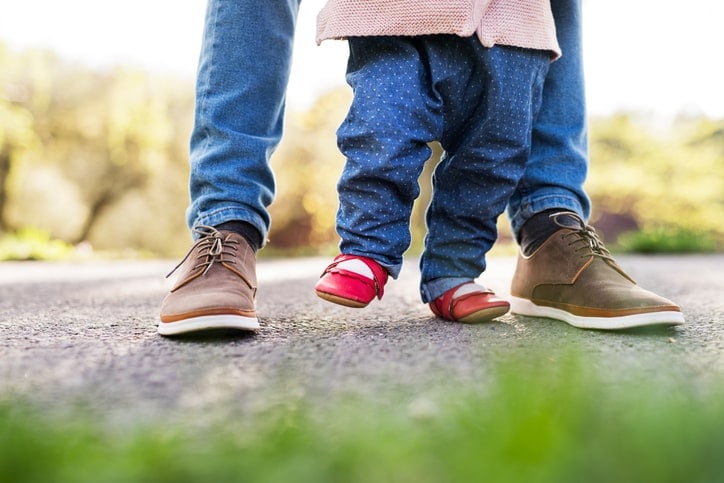
When do babies beginning walking?
In the United States today, the average age of independent walking is approximately 12 months. Researchers written report like timing for babies in a number of other countries, including Argentina, Ghana, India, Norway, Oman, South Africa, and Turkey.
On average, babies in these countries take their first, unassisted steps at effectually 12-13 months (WHO 2006a; Ertem et al 2018).
But there are cultures where most babies brainstorm walking months earlier – or many months afterward. And fifty-fifty within a single society, the range of individual variation can be huge.
For example, in a study tracking the development of 220 children in Switzerland, a few babies began walking independently at eight.5 months. And some babies didn't walk until they were most 20 months one-time.
Still all of these children experienced healthy, normal outcomes.
The timing of independent walking was unrelated the children's later motor development and cognitive ability (Jenni et al 2013).
Of course, that isn't always the instance. Sometimes delays in the onset of walking are caused past medical conditions or developmental disorders. But almost late walkers don't have these issues.
So what'southward normal? What should nosotros wait? How can we tell if a baby is ready to walk, and what makes some babies begin walking before than others?
Here'southward an overview, starting time with the motor skills that babies must master earlier they get-go walking on their own.
What are signs that a babe volition walk soon?
Earlier they tin can walk, babies need to develop the strength and coordination to maintain an upright posture on their ain. They too need to be able to conduct most of their weight – at to the lowest degree momentarily – on i pes.
So babies are moving closer to independent walking when they display these motor skills:
Pulling oneself up into a continuing position (past gripping piece of furniture, or holding onto someone)
Typically, babies develop this ability well-nigh iv months earlier they accept their first, independent steps (Ertem et al 2018).
During early attempts, a baby will exist able to remain standing for only a few seconds, and you will notice that the baby's legs are stiff and straight (every bit they are in this photograph).
Merely as the baby gets stronger, he or she volition be able to stand up comfortably — with knees slightly flexed — while holding on.
Walking with support

At this stage, babies have the force to shift their weight from one leg to the other. If you hold a baby by the hands, he can walk forward. If a baby grabs onto a piece of furniture, she tin can "prowl," or move along sideways.
When will a baby with these abilities begin walking independently?
Studies propose that independent walking tends to emerge about 3 months later (WHO 2006a; Ertem et al 2018). Only there's no strict sequence that all babies follow. Some babies begin walking with support relatively early on — even before they have learned to crawl. For these babies, the side by side stagemight be independent walking. Only babies might also shift their focus to itch (WHO 2006b).
Standing alone (at to the lowest degree momentarily).
How long after learning to stand up unassisted do babies begin to walk?
International studies propose that almost babies showtime walking within 2-3 months of learning to stand (Ertem et al 2018). But information technology isn't the accented passage of time that matters and so much. It's the sheer amount of practise and difficult piece of work.
When babies are learning to walk independently, they fall down. A lot. Some babies don't seem to mind much. They enthusiastically throw themselves into the project, and learn to walk rather chop-chop — sometimes within a few days of learning to stand up.
What almost crawling? Practise babies accept to clamber before they can walk?
Absolutely not. In fact, some babies never crawl. Read more about information technology in my article opens in a new window"When exercise babies clamber, and how does itch develop: An illustrated guide."
And so when tin can babies walk with support?
International research suggests that approximately one-half of all babies have begun walking with support past the time they are 9 and half months old (WHO 2006a; Ertem et al 2018). Only local norms vary.
In cultures where parents actively teach their babies to walk, infants may brainstorm assisted walking by 7-8 months (e.chiliad., Super 1976).
In places where parents accept a more easily-off arroyo, the boilerplate onset of walking with support is later – closer to 10.5 months (WHO 2006a).
And in cultures where babies remain physically restrained throughout the day – in carriers, slings, cradles, and other devices – babies don't begin walking until much afterwards.
When exercise babies make the transition to contained walking?
As noted in the introduction, there is a wide range of variation here. Some babies brainstorm before they are 9 months erstwhile. Others accept xviii months or more than.
Why is in that location and so much variation, and what sort of factors predict whether a child will walk before or later?
Homo bipedalism is a difficult trick to larn. Babies face many obstacles, including their own bodies.
For instance, a infant with skinny legs – and a higher muscle-to-fatty- ratio – will have an easier fourth dimension fighting gravity, and may begin walking sooner than a plumper, less muscular baby (Adolf 2008).
The timing of walking also depends on opportunities for movement and do.
In full general, babies who get more exercise – time exterior a sling, crib, or cradle – tend to achieve motor milestones before in life. More specifically, babies acquire to walk earlier if they get lots of practise with "assisted walking" — taking steps frontward while someone holds their hands.
Motivation is probably important, too. For example, researchers have institute that babies are more probable to start learning to walk if they evidence an interest in accessing distant objects (Karasik et al 2011).
And something as mundane as clothing can make a difference.
Experimental research confirms that it's harder for babies to walk when they are wearing diapers. The bulk gets in the way – forcing them to waddle with their legs further autonomously – and babies are more likely to lose their balance and autumn (Cole et al 2012).
Together, these factors can help explain why babies vary as individuals. They tin also shed light on some of the dramatic differences we observe between cultures.
How do parenting practices affect the development of walking?
Consider the Kipsigis of Kenya, people who enhance crops and herd cattle. In this culture, parents actively encourage infants to develop motor skills essential for walking.
Information technology begins with something called the stepping reflex: Hold a newborn baby upright – allowing his or her feet to touch the basis – and the baby will announced to have alternating steps. As if the baby is prepare to walk!
Of class, the baby isn't really set up to walk, non withal. Young babies lack the musculus development, coordination, and body proportions to walk successfully when they are very young. And if we simply ignore this stepping response, the behavior will eventually fade.
In Western countries, for example, the stepping response usually disappears by the time babies are eight weeks one-time.
Just the Kipsigis don't ignore the stepping reflex. Instead, they plow it into a game. Supporting babies by the armpits, mothers bounce their babies on their laps, stimulating the stepping reflex.
The games starting time when babies are about one calendar month old, and babies experience daily practice. Past the time they are 7-viii months old, infants are potent plenty to brainstorm walking (with support) on the ground.
In that location is never a point when babies lose the stepping response. Instead, there is a continuous, gradual development of e'er-stronger stepping (Super 1976).
When researchers tested a similar arroyo on babies living in the United States, they noticed the same matter: Babies didn't lose the stepping response over time, not when they were encouraged to exercise it (Zelazo 1983).
And in both groups — Kipsigis and Americans — researchers observed a human relationship betwixt practice and the timing of walking. Babies who skilful footstep-walking tend to walk independently at an before age (Super 1976; Zelazo 1983).
And then parents can stimulate the development of walking through exercise and play. And the reverse is true as well:
When babies experience movement restriction – by being held, swaddled, or immobilized every day – they begin walking later (Adolph and Robinson 2013).
For an extreme case, consider the Ache of Paraguay, people who practiced hunting and gathering until the late 20th century.
When they were living in the erstwhile, traditional fashion, the Ache carried their babies almost constantly. They regarded their surround – the Amazonian rain woods – to be too unsafe to set infants down.
So Ache babies didn't get opportunities to practise walking, and, as a upshot, children didn't learn to walk until they were approximately 24 months one-time (Kaplan and Pigeon 1987).
I call this an extreme instance, but "farthermost" is a relative term: Information technology depends on what populations you utilize for comparison. The Ache aren't the simply hunter-gatherers who avoided setting their babies on the ground. And people in other societies follow community that restrict babe motion.
For instance, throughout Key Asia, babies spend long hours each day restrained in a traditional cradle called a "gahvora" (Karasik et al 2018).
In dissimilar times and places, it might have been pretty common for babies to miss out on the sort of experiences that atomic number 82 to early walking. And that should brand u.s. re-evaluate our ideas nearly what constitutes "normal" evolution.
It doesn't make sense to talk about "normal" timing in a vacuum, as if local differences in the environs don't matter.
When should a parent be concerned? At what bespeak is a child considered to have developmental delay?
Organizations like the American Academy of Pediatrics recommend that y'all talk with your dr. if your babe can't walk past the age of 18 months. And that's adept advice. Sometimes, being "slow to walk" is a sign of a physical problem, and then it's expert to investigate early on, and accept action.
But proceed in mind: About babies who haven't all the same begun walking at 18 months practise not suffer from developmental problems. Not if they are otherwise healthy.
More reading almost baby development
Every bit we've seen, babies don't larn to walk on a stock-still time schedule. The timing tin can vary dramatically from one private to the next. The aforementioned is truthful for many other motor skills. To acquire more virtually it, see my article on opens in a new windowbaby motor milestones.
In addition, check out my guide to the opens in a new windowdevelopment of crawling, as well as these articles virtually baby evolution:
- opens in a new windowWhen do babies say their first words?
- Can babies sign before they speak?
- opens in a new windowExercise babies feel empathy?
- Can babies sense stress in others?
- opens in a new windowTin babies tell when their parents are fighting?
- opens in a new windowMoral sense: Babies prefer underdogs and practice-gooders
- opens in a new windowStress in babies: How to keep babies calm, happy, and emotionally salubrious
- opens in a new windowHow friendly eye contact can make infants tune in — and mirror your brain waves.
References: When exercise babies showtime walking?
Note to the scholarly: If y'all desire to swoop into the scientific literature about walking, be sure to check out the piece of work of Karen Adolph and Lana Karasik.
Adolph heads a research team at New York University. Many of her lab'southward publications can be downloaded for free from this folio. Karasik is currently at the College of Staten Isle, CUNY. Her lab's publication page is hither.
Adolph KE. 2008. Motor and physical development: Locomotion. In M. M. Haith & J. B. Benson, (Eds.), Encyclopedia of baby and early on childhood evolution (pp. 359-373). San Diego, CA: Academic Printing.
Adolph KE and Robinson SR. 2013. The road to walking: What learning to walk tells united states about development. In P. Zelazo (Ed), Oxford handbook of developmental psychology (pp. 403-443). Oxford: Oxford University Printing.
Cole WG, Lingeman JM, Adolph KE. 2012. Go naked: diapers bear upon infant walking. Dev Sci. 15(6):783-xc
Kaplan H and Dove H. 1987. Infant development amongst the Ache of eastern Paraguay.Developmental Psychology, 23(ii): 190–198.
Karasik LB, Tamis-LeMonda CS, Ossmy O, and Adolph KE. 2018. The ties that demark: Cradling in Tajikistan. PLoS Ane, thirteen(10): e0204428–18.
Karasik LB, Tamis-LeMonda CS, and Adolph KE 2011. Transition from itch to walking and infants' deportment with objects and people. Child Evolution, 82, 1199-1209.
Jenni OG, Chaouch A, Caflisch J, and Rousson V. 2013. Infant motor milestones: poor predictive value for outcome of salubrious children. Acta Paediatrica 102 (four): e181
Super CM. 1976. Ecology furnishings on motor development: the case of "African baby precocity". Dev Med Child Neurol. xviii(five):561-7.
WHO Multicentre Growth Reference Study Group. 2006a. Assessment of sexual practice differences and heterogeneity in motor milestone attainment amid populations in the WHO Multicentre Growth Reference Study. Acta Paediatr Suppl. 450:66-75.
Zelazo PR 1983. The development of walking: New findings and old solutions. Journal of Motor Behavior fifteen: 99-137.
Content of "When practice babies start walking" last modified 3/ten/2022
Epitome credits for "When exercise babies start walking":
image of toddler'south and parent'south legs by Halfpoint/ istock
prototype of penguins by Ky0n Cheng / flickr (public domain)
image of mother helping baby walk by opens in a new windoweggeeggjiew / istock
guajardoanchoughboad1982.blogspot.com
Source: https://parentingscience.com/when-do-babies-start-walking/
0 Response to "Can Baby Growning Fast Cuase Them to Have Trouble Walking"
Postar um comentário